There’s no such thing as a universal dump trailer. What works for a weekend property owner clearing brush won’t keep pace with a landscaping crew running six days a week. And what a landscaper needs is a different specification than a concrete demo contractor loading mixed debris. Buying a dump trailer is a capacity and application decision — and getting it wrong costs you in productivity every single haul.
This guide breaks down the key factors to evaluate when choosing a dump trailer for landscaping and construction work, and why the Delco DD — a 20,000 lb GVWR Tandem Dual Gooseneck — sits at the top of the spec sheet for serious operators in both industries.
Start With GVWR: Match the Trailer to the Load
Gross Vehicle Weight Rating is the first number that matters. GVWR sets the ceiling on how much your trailer — loaded with material, including its own weight — can legally and safely operate. Underestimate your needs here and you’re looking at overloaded axles, premature wear, and potential liability.
For occasional landscaping work — mulch, topsoil, light gravel — a 12,000–14,000 lb bumper pull may cover you. But for contractors moving dense material like compacted fill, wet dirt, or demolition rubble on a daily basis, the numbers add up fast. A cubic yard of wet concrete weighs over 4,000 lbs. A 14K trailer maxed out on wet material has almost no margin left.
Heavy landscaping and commercial construction work demands 20,000 lb GVWR and above — and that’s where the Delco DD lives.
Bumper Pull vs. Gooseneck: More Than Just Hitch Style
The choice between bumper pull and gooseneck isn’t just about what ball your truck has. It’s about stability, payload distribution, and tow vehicle capability.
A bumper pull trailer connects behind the bumper, placing all tongue weight at the rear of the tow vehicle. This works well for lighter loads and shorter hauls. A gooseneck connects via a ball in the truck bed, distributing weight directly over the rear axle. At higher payloads, that weight distribution difference is critical — it improves stability at highway speeds, reduces trailer sway under load, and allows the tow vehicle to handle more responsively.
If you’re pulling heavy loads regularly — especially on mixed terrain or longer haul distances — a gooseneck configuration is the correct engineering specification for the job. The Delco DD is built around that logic.
The Delco DD: Built for the Operators Who Never Underspec
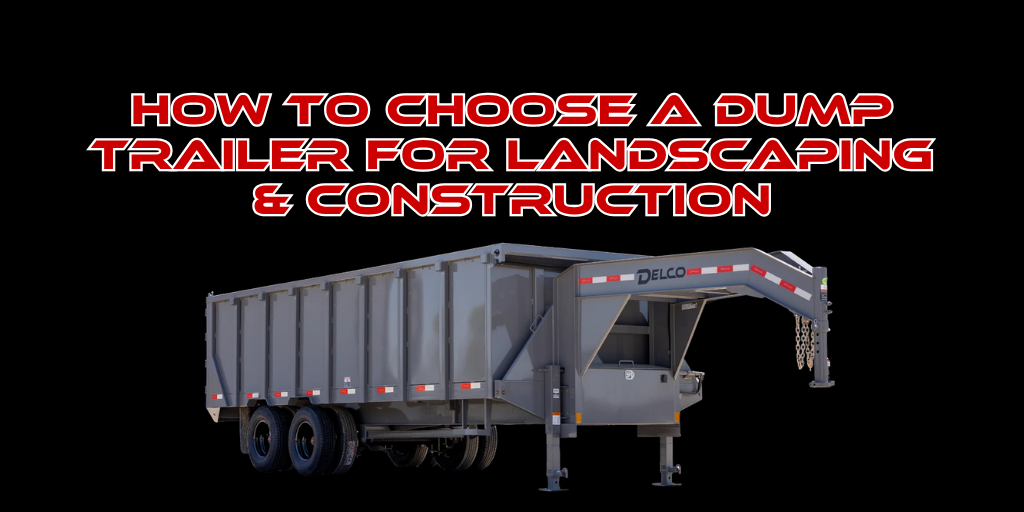
The DD is Delco’s flagship dump trailer for high-volume commercial operations. At 20,000 lb GVWR with a Tandem Dual axle gooseneck configuration, it’s engineered for the contractor who doesn’t want to make compromises in the field.
The tandem dual axle setup distributes load weight across four axle positions, reducing stress on any individual point and allowing the trailer to hold up under repeated heavy loading cycles that would wear lesser trailers down. The gooseneck connection anchors the load distribution where it belongs — over the truck’s rear axle — giving you the control and stability that a bumper pull simply can’t replicate at this weight class.
Like every Delco dump trailer, the DD ships with a standard pull-back tarp system, Midnight Black powder coat, hydraulic lift, and electric brakes — features that competing manufacturers frequently list as paid upgrades.
Cylinder Type Matters: Single-Stage vs. Telescopic
For landscaping and construction applications where dense or wet material is common, the lift system is a critical spec point. A standard single-stage hydraulic cylinder provides reliable lift for lighter loads, but on heavier, compacted material, its mechanics work harder — and the transit height of a fully extended single-stage cylinder can be a problem in low-clearance environments.
Delco’s D5 and D6 models use a multi-stage telescoping cylinder, which generates more lifting force from a shorter collapsed length. If your work regularly involves dense material — compacted fill, river rock, wet mulch — the telescoping cylinder is worth understanding before you spec your trailer.
The DD operates with its own hydraulic configuration matched to its 20K capacity. Talk to your dealer about cylinder options based on your material profile.
Tarp System, Powder Coat, and the Details That Matter
Two details that get overlooked during a purchase — and cause frustration in the field — are material containment and finish durability. Delco addresses both at the standard level.
Every Delco dump trailer ships with a pull-back tarp system as standard equipment. No options menu, no upcharge. Material stays contained in transit, loads stay dry in weather, and you stay compliant on roadways where material loss creates liability. The Midnight Black powder coat applied to every model is corrosion-resistant and UV-stable — built to maintain its appearance through years of job site exposure.
How to Make the Decision
If you’re choosing a dump trailer for landscaping and construction work, the framework is straightforward: match GVWR to your real load profile (not your lightest load, your typical load), choose gooseneck if your weight class and haul distance call for it, and don’t spec down on cylinder type if your material is dense.
For serious operators, the Delco DD is the answer to that checklist. For operators in an earlier stage of business building toward that capacity, the D3 or D4 at 14K may be the right starting point — with a clear upgrade path as the business grows.
Delco’s 183+ authorized dealers are equipped to walk through that decision with you based on your specific application, region, and tow vehicle.
Talk to your local authorized Delco dealer about the DD and the full dump trailer lineup at delcotrailers.com/locate-a-dealer.